Nobody tells you what this part is for.
You worked for forty years and they gave you a card and a handshake, and then it was Tuesday and nobody needed you. That is the part no one warns you about. Not your health, not your will, not the funeral. The boredom. The phone that doesn't ring. The money you are frightened to spend. I have spent thirty years in old people's front rooms watching who comes through this well and who quietly goes under — and it is never who you would guess. Here is what the ones who flourish do differently.
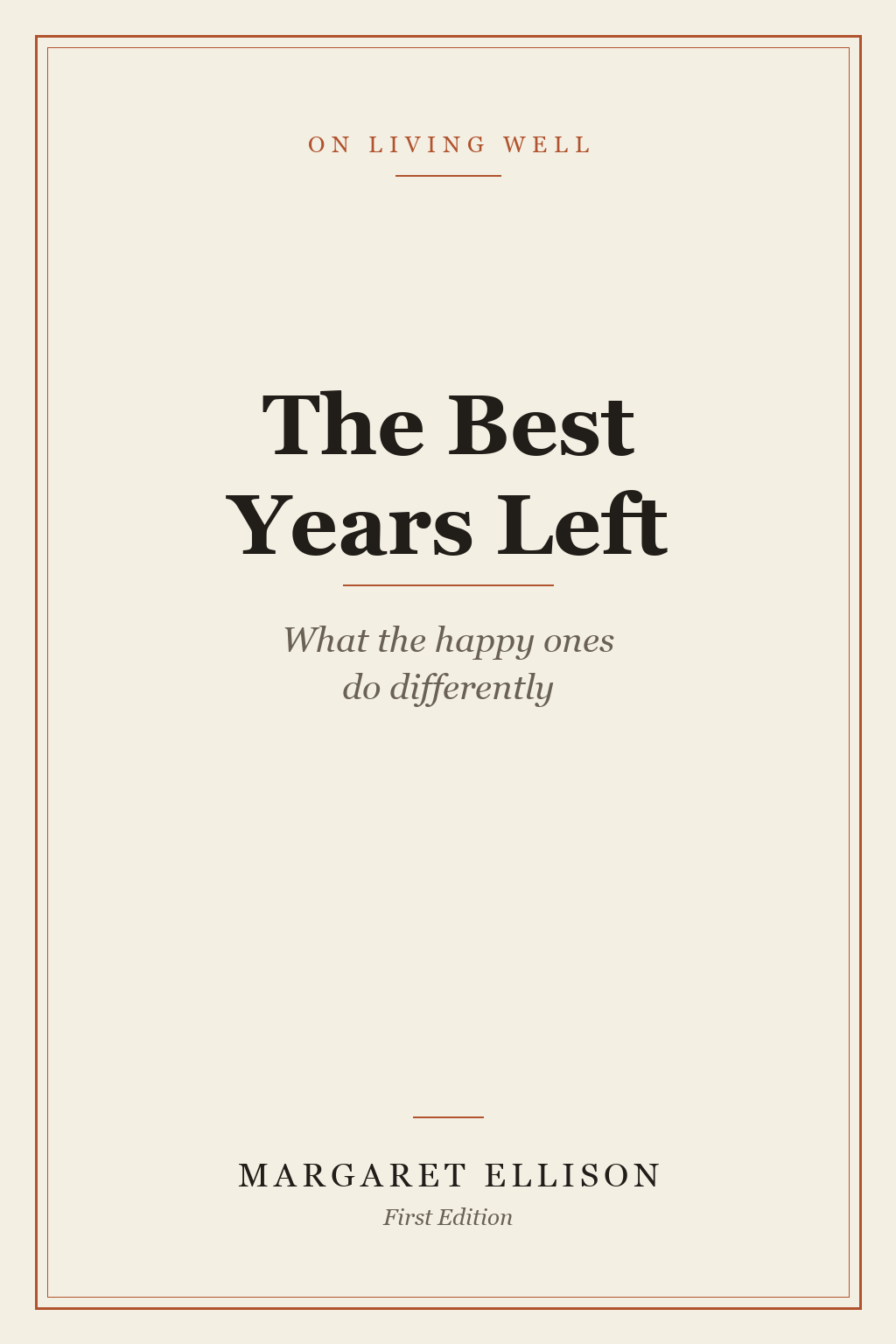
Forty-eight short chapters. Not one of them tells you to eat more fibre.
No regime. No thirty-day plan. No "golden years." You have had a lifetime of being told what to do, and you did not buy a book to be told again.
- The Best Years Left — the complete book$49270 pages. Forty-eight short chapters on the part of life nobody prepares you for — the boredom, the quiet phone, the money you're frightened to spend, and being talked over by people half your age.
- Part IV · Money Without Fear$19Eight chapters on the saver's curse — why spending what you spent forty years saving feels like a crime, and how they will try to cheat you out of it.
- Part III · The Quiet Phone$15How to make a friend at seventy without it being strange, and the call you keep not making because you don't want to be a bother.
- Part V · Being Spoken To Like an Adult$14Asking for help without surrendering. Accepting it without resenting it. And the word "sweetheart."
- Lifetime updates$14Every future edition, free, forever.
- Total value $111 — you pay once$111$47
You have said one of these this month. Probably to nobody.
Every chapter opens on a sentence you have said in your own head and never out loud — and then takes it apart.
Nothing here is medical or financial advice — your body belongs to your doctor and your money to somebody qualified. This book is about everything else.
Exactly what is in the book.
Six parts. Read them in any order you like.
- The Tuesday nobody needed me
- Why the first two years are the worst
- You didn't retire from a job — you retired from being someone
- Hobbies are a trap
- Learn something hard enough to be bad at
- What to do with a Sunday
- How to make a friend at seventy without it being strange
- The phone call you keep not making
- Saying the thing while there is still someone to say it to
- The saver's curse
- How they will try to cheat you — and the three sentences that end it
- Giving it while you are alive to watch
- When they talk over your head to whoever brought you
- Asking for help without surrendering
- Driving: the one nobody says out loud
- Bucket lists are a marketing invention
- What you regret is never what you expected
- The things you can still start
About Margaret.

Margaret Ellison has spent thirty years in other people's front rooms — as a companion and a home helper, never in a clinic. She started because of her own mother, and got her own mother badly wrong. Then she did it for a living, for three decades, in hundreds of houses.
When you sit in that many armchairs, she says, you stop seeing individuals and start seeing a pattern. Some people come through this stretch of life genuinely well. Others — with the same money, the same health, the same children — quietly go under. She knows what separates them, because she was in both houses.
Margaret is not a doctor, a therapist, or a financial adviser, and there is no medical or financial advice in this book — deliberately. Your body belongs to your doctor. Your money belongs to somebody qualified and independent. This book is about everything else.
$47 once. Yours to keep, for however many years you have got.
No subscription. One payment, lifetime access, free updates.
- The Best Years Left — the complete book$49270 pages. Forty-eight short chapters on the part of life nobody prepares you for — the boredom, the quiet phone, the money you're frightened to spend, and being talked over by people half your age.
- Part IV · Money Without Fear$19Eight chapters on the saver's curse — why spending what you spent forty years saving feels like a crime, and how they will try to cheat you out of it.
- Part III · The Quiet Phone$15How to make a friend at seventy without it being strange, and the call you keep not making because you don't want to be a bother.
- Part V · Being Spoken To Like an Adult$14Asking for help without surrendering. Accepting it without resenting it. And the word "sweetheart."
- Lifetime updates$14Every future edition, free, forever.
- Total value $111 — you pay once$111$47
Fair questions before you spend $47.
Is this a health book?
No, and pointedly so. There is not one word in it about diets, exercises, symptoms or medicines. Your body is your doctor's business. This book is about the part of being old that nobody else will discuss with you.
Is this financial advice?
No. The money chapters are about the fear — why spending what you spent forty years saving feels like a crime, and how people will try to separate you from it. What to actually do with your money belongs to somebody qualified and independent, and Margaret tells you how to find one and how to tell when you are being handled.
I'm not retired yet. Is it too early?
It is the best possible time. In Margaret's experience the people who came through this stretch best were the ones who saw it coming. The ones who got blindsided by it lost years working it out alone.
I'm seventy-eight. Is it too late?
No. Very little in here depends on how many years you have left, and the chapters about saying the things that need saying get more urgent, not less.
Is it going to be depressing?
It is a book about living, written by a woman who is dry, blunt and rather funny about her own mistakes. It is not sad and it is not sentimental. If you want to be told about your golden years, buy a different book.
What format is it, and how do I get it?
A PDF you can read on any phone, tablet or computer, and print if you like. The type is set large on purpose. You download it the moment you have paid, and it is emailed to you as well.
What's the refund policy?
7 days, no questions asked. If it doesn't help you, write to us and we'll refund every cent.